(April 2004) New metropolitan area definitions from the U.S. Office of Management and Budget draw attention to the critical needs of children living in remote areas. Under the old (1999) definitions, the child poverty rate in metropolitan counties was 16 percent, compared with 19 percent for children in nonmetropolitan counties. Under the new definitions, the child poverty rate in 1999 was 21 percent in rural areas and 16 percent in metropolitan areas (see Figure 1). A new category, “micropolitan”* fell in between, with a child poverty rate of 18 percent. This national pattern was replicated in most of the states. There were only seven states where nonmetro child poverty rates did not exceed the rates in both metropolitan and micropolitan areas.
Figure 1
Children Living in Poverty, by Metropolitan Area Status, 1999
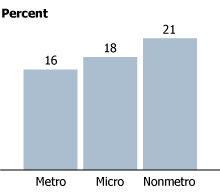
Population Reference Bureau, analysis of data from the 2000 Census
Most states that had high rural child poverty rates also had relatively high rates in metro areas. But in a few states, including Arizona, Kentucky, and North Dakota, the child poverty rate in the nonmetro portion of the state was twice as high as the metro rate (see Table 1). In South Dakota, the child poverty rate in nonmetro areas (29 percent) was nearly three times the rate in metro counties (11 percent).
It is not immediately clear what economic, demographic, and policy factors lead to these striking differences within states. In the case of South Dakota, most of the nonmetro counties are within or adjacent to American Indian reservations. Excluding micropolitan counties from nonmetro areas, as the new definitions do, causes South Dakota’s rural child poverty rate to increase by more than a third. At the state level, child poverty rates in South Dakota and elsewhere have decreased in recent years, but child poverty rates in rural areas have remained unacceptably high. Although the new metropolitan area definitions have complicated analyses of rural/urban differences, they underscore the urgency of assistance to rural children.
Table 1
Children Living in Poverty, by State and Metropolitan Area Status, 1999
| State | Child poverty rate (%) | ||
|---|---|---|---|
| Metro | Micro | Nonmetro | |
| United States | 15.9 | 18.5 | 21.2 |
| Alabama | 20.2 | 21.5 | 27.5 |
| Alaska | 9.9 | 8.0 | 17.1 |
| Arizona | 17.7 | 25.0 | 38.9 |
| Arkansas | 19.5 | 24.9 | 25.0 |
| California | 19.4 | 20.6 | 20.5 |
| Colorado | 10.6 | 12.7 | 17.0 |
| Connecticut | 10.7 | 7.1 | |
| Delaware | 11.6 | 15.3 | |
| Florida | 17.2 | 23.4 | 24.0 |
| Georgia | 15.2 | 23.7 | 26.0 |
| Hawaii | 12.9 | 16.9 | N/A |
| Idaho | 12.8 | 16.2 | 18.0 |
| Illinois | 14.3 | 14.0 | 15.5 |
| Indiana | 12.3 | 11.5 | 12.4 |
| Iowa | 10.4 | 12.6 | 11.2 |
| Kansas | 10.3 | 15.0 | 14.3 |
| Kentucky | 15.6 | 24.1 | 30.4 |
| Louisiana | 24.8 | 30.9 | 34.6 |
| Maine | 11.8 | 13.5 | 17.4 |
| Maryland | 10.5 | 12.4 | 16.5 |
| Massachusetts | 12.0 | 8.5 | |
| Michigan | 14.1 | 11.2 | 15.2 |
| Minnesota | 8.9 | 10.9 | 12.1 |
| Mississippi | 21.5 | 30.6 | 31.5 |
| Missouri | 13.9 | 19.3 | 22.4 |
| Montana | 16.2 | 15.5 | 24.2 |
| Nebraska | 11.1 | 13.3 | 14.4 |
| Nevada | 14.2 | 10.9 | 14.1 |
| New Hampshire | 7.2 | 8.4 | 10.6 |
| New Jersey | 11.1 | ||
| New Mexico | 22.0 | 29.7 | 31.2 |
| New York | 20.2 | 17.5 | 18.6 |
| North Carolina | 14.3 | 19.3 | 22.0 |
| North Dakota | 10.2 | 13.3 | 19.2 |
| Ohio | 14.5 | 13.6 | 15.7 |
| Oklahoma | 17.8 | 21.2 | 24.9 |
| Oregon | 13.5 | 18.7 | 19.1 |
| Pennsylvania | 14.6 | 14.6 | 16.8 |
| Rhode Island | 16.9 | ||
| South Carolina | 17.1 | 21.7 | 29.6 |
| South Dakota | 10.9 | 12.2 | 29.0 |
| Tennessee | 17.3 | 19.4 | 20.5 |
| Texas | 19.8 | 26.3 | 24.1 |
| Utah | 9.3 | 14.8 | 16.6 |
| Vermont | 9.1 | 11.6 | 14.1 |
| Virginia | 11.3 | 15.2 | 19.5 |
| Washington | 12.9 | 18.3 | 22.3 |
| West Virginia | 20.7 | 27.2 | 29.8 |
| Wisconsin | 11.4 | 8.5 | 12.9 |
| Wyoming | 14.4 | 13.7 | 15.7 |
Note: Metropolitan and micropolitan counties are classified based on 2003 OMB definitions. There are a few states without any micropolitan and/or nonmetropolitan counties. Data for nonmetropolitan Hawaii are not shown because of the small sample size.
Source: Population Reference Bureau, analysis of data from the 2000 Census.
Mark Mather is director of the Rural Families Data Center at PRB. William O’Hare is a social demographer who directs the KIDS COUNT project at the Annie E. Casey Foundation in Baltimore.
For More Information
For more information about child poverty in rural areas, see William O’Hare and Kenneth Johnson, “Child Poverty in Rural America,” PRB Reports on America 4, no. 1 (2004), available online at www.rfdcenter.org.
* The new metropolitan area definitions, issued in June 2003, include an additional category of “micropolitan” counties. Micropolitan statistical areas include urban clusters of 10,000 to 50,000 people, the county where the urban cluster is located, and adjacent counties linked by commuting ties. Metropolitan areas are based on an urban core of at least 50,000 people. Any county that is not in a metropolitan or micropolitan area is considered nonmetropolitan. Under the new definitions, there are four states
Connecticut, Delaware, New Jersey, and Rhode Island
that have no nonmetro areas, and three states
Massachusetts, New Jersey, and Rhode Island
where there are no micropolitan areas.