By Linda A. Jacobsen Digital and Economic Divides Put U.S. Children at Greater Educational Risk During the COVID-19 Pandemic In 2018, roughly 10% of U.S. children ages 5 to 17 did not have a computer desktop, laptop, or tablet at home, and 23% did not have home access to paid high-speed internet. Fully one-fourth of all school-age children were lacking either a computer or high-speed internet. August 18, 2020
By Beth Jarosz, Sung S. Park and Fabian T. Pfeffer Disadvantage for Black Families Compounded by Economic Circumstances of Kin Race may be a social construct but it s one with consequences that may span generations. While both Black and white families can experience upward or downward wealth mobility from one generation to the next, studies show the dramatic socioeconomic disadvantages for Black families have persisted a… April 16, 2020
By Mark Mather and Beth Jarosz Workers at Risk During the Coronavirus Pandemic: Four in 10 Food Preparers and Servers Are Low-Income The COVID-19 pandemic sweeping the globe in 2020 will have long-term and widespread effects on the U.S. economy and labor force. A PRB analysis finds that workers in one of the hardest-hit sectors food preparation and server-related occupations are among the most economically vulnerable. March 26, 2020
By Mark Mather and Beth Jarosz The Nation s Preexisting Condition: How Rising Inequality Exacerbated the Economic Toll of the Coronavirus Rising income inequality and a shift to lower-wage service jobs placed millions of working Americans in vulnerable economic positions with limited savings or job benefits to cushion the coronavirus pandemic s economic toll. March 31, 2021
By Kelvin M. Pollard and Linda A. Jacobsen New Report Explores Appalachia s Current Strengths and Vulnerabilities The latest report on the Appalachian Region can help state and local policymakers build community capacity and strengthen economic growth. June 10, 2020
By Amanda Lee, Lillian Kilduff and Mark Mather U.S. Homeownership Rates Fall Among Young Adults, African Americans The overall homeownership rate dropped two percentage points between 2000 and 2017. This decline can be explained in part by changes in the racial and ethnic composition of householders. February 13, 2020
By Deborah Mesce Population Growth Concentrated Among the Poorest Communities As sub-Saharan African countries strive to grow their economies, it is critical that they consider their age structures or more particularly, the age structures of their richest and poorest populations, which are determined largely by fertility rates. Comparing these can unmask an imbalance that, if… December 10, 2018
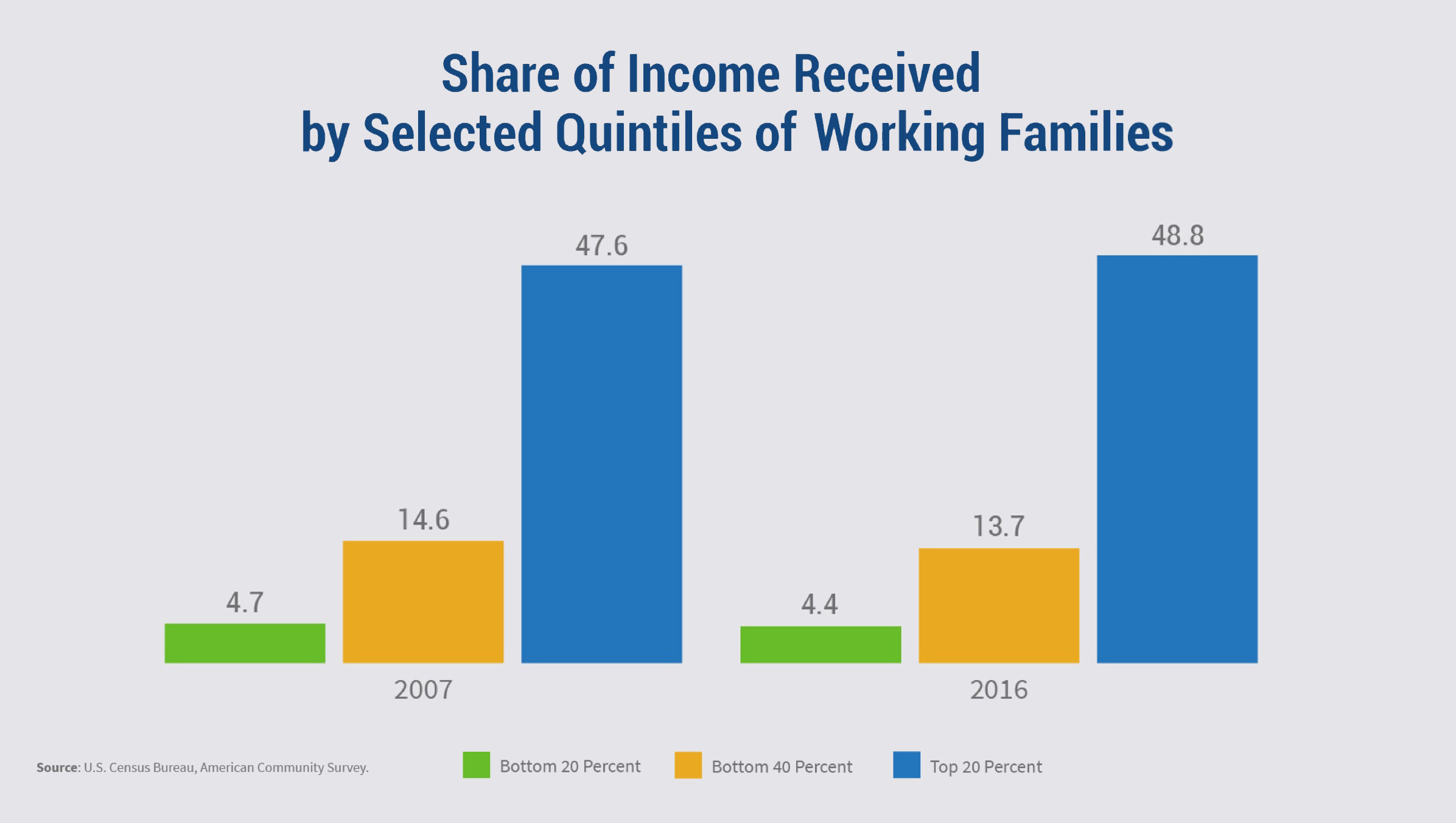
By Beth Jarosz and Mark Mather Income Inequality Among U.S. Working Families While the U.S. economy has shown signs recovery since the Great Recession, inequality among America million working families has increased. The unemployment rate has fallen from post-recession high 9.6 percent 2010 4.4 percent 2017 lowest level since 2000. However, gains the lower end the income spe… May 11, 2018
By Kaitlyn Patierno, Imelda Feranil and Meghan Reidy Enhancing Family Planning Equity for Inclusive Economic Growth and Development Across sub-Saharan Africa, national development strategies have established the goal of achieving economic growth that is both rapid and equitable across a population. Efforts to promote shared prosperity will be strengthened by demographic changes that facilitate greater investment in human capital… April 19, 2018
By Toshiko Kaneda and Marlene A. Lee Benefit of Canning-Karra-Wilde Model in Policy Planning Researchers from the Population and Poverty Research Network (PopPov) have developed a macroeconomic model that estimates the impact of fertility declines on economic growth. The model is especially useful in country-level policy planning. September 13, 2017
By Marlene A. Lee and Jocelyn E. Finlay The Effect of Reproductive Health Improvements on Women's Economic Empowerment With increased attention to women s economic empowerment among donors and policymakers across the globe, we are at a pivotal moment for reviewing the current state of the research on women s economic empowerment to identify gaps. September 6, 2017
By Assefa Admassie, Seid Nuru and Shelley Megquier Maximize Ethiopia s Potential to Reap a Demographic Dividend Declining mortality and fertility rates are transitioning Ethiopia toward an age structure that has the potential to provide significant economic benefit. August 1, 2017
By Toshiko Kaneda and Reshma Naik Tackling the Growing Noncommunicable Disease Epidemic This policy report argues that integrating noncommunicable disease (NCD) services particularly those targeted at prevention and early intervention with other health services for young people can help tackle the growing NCD epidemic in low- and middle-income countries (LMICs). May 10, 2017
By Marlene A. Lee, Hanna Christianson and Kristin Bietsch Global Employment and the Sustainable Development Goals The United Nations Sustainable Development Goal 8 calls for full and productive employment and decent work for all. In our latest Population Bulletin, we explain how demographic trends will have a bearing on whether and how rapidly this and other SDG goals are achieved. April 18, 2017
By Kelvin M. Pollard and Linda A. Jacobsen The Appalachian Region: A Data Overview From the 2011-2015 American Community Survey Appalachia s unemployment and poverty rates remain above levels seen before the economic downturn of 2007-2009, suggesting an incomplete economic recovery, especially in many of the Region s most rural counties, according to a new PRB report for the Appalachian Regional Commission. April 3, 2017